



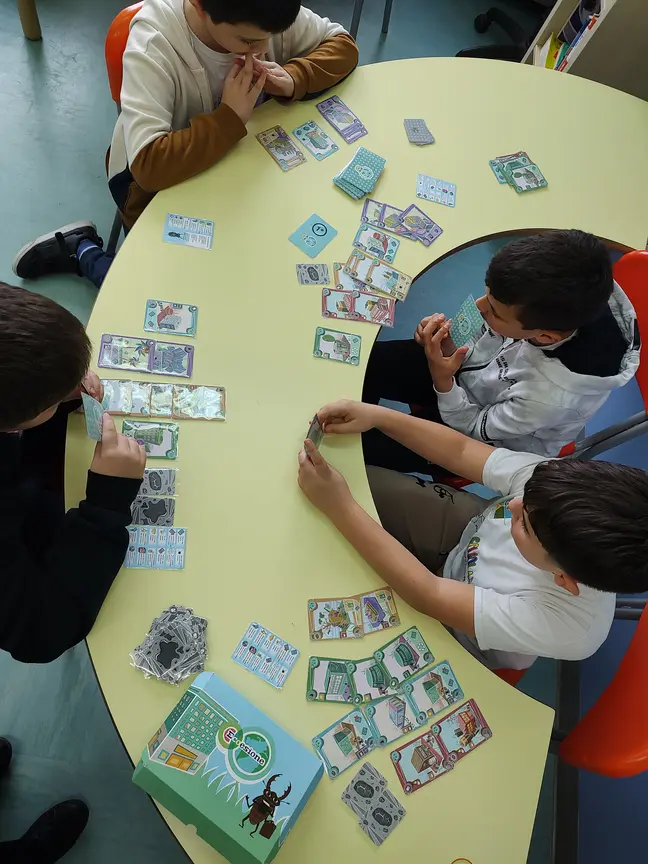
Ecohesion: the Game
A game to understand the transition
Ecohesion is a strategic card game about the ecological and social transition. It was created as part of a University of Pisa research project on social cohesion in the ecological transition and is now being developed with the support of the academic spin-off Ecohesion. The game mechanics and graphics, designed by Golem’s Lab, turn a complex issue into an accessible and engaging experience, suitable both for recreational play and for educational and training activities.
How can we build a society in which everyone can live well while respecting the limits of nature?
How it works
The game represents a society that has grown through the use of fossil resources and must transform itself before those resources run out. During the game, players build facilities, public services, productive activities, energy infrastructure, recycling systems and innovations. Each choice contributes to the development of their own playing area, but also requires resources, generates consumption and affects the options available in subsequent turns.
Coal, oil and gas come from a limited global reserve. Their gradual depletion sets the pace of the game and makes it clear that individual decisions take place within shared constraints.
Winning is not simply a matter of accumulating points. Each player must achieve at least five of the United Nations Sustainable Development Goals. The SDGs are therefore not merely a decorative element: they represent the different dimensions that a genuinely sustainable transformation must bring together — environment, energy, work, services, innovation, inclusion and quality of life.
For more information, to use the game in educational and training programmes, or to purchase it, contact us at ecoesione@posteo.net.
Three objectives to balance
In simplified form, Ecohesion explores the trilemma between material prosperity, ecological sustainability and equity. Developing economic activities and services can improve well-being, but it can also accelerate resource consumption. Reducing environmental impacts may require investment, short-term sacrifices or changes to established strategies.
A choice that benefits one player may impose costs on others, bringing forward the depletion of a shared resource or reducing the opportunities available to them. At the same time, innovation, recycling and more balanced combinations of choices can alter these trade-offs and open up pathways that were previously unavailable.
Is the winner of the game also the person who contributed most to the best outcome for society as a whole?
Trade-offs to explore, not simply accept
The trilemma should not be understood as an immutable law according to which progress in one dimension necessarily comes at the expense of another. Some constraints are physical and cannot be ignored; others depend on the rules, the technologies adopted and the way resources, opportunities and decision-making power are distributed.
The game therefore encourages players not to search for a single “optimal” choice, but to experiment with combinations that can make well-being, social justice and sustainability more compatible. In this sense, trade-offs become design challenges: they indicate where innovation, different rules or complementary interventions are needed.
A learning pathway
Ecohesion can become the centre of a learning pathway structured around three stages: before, during and after the game. The game does not provide a predetermined answer. Instead, it creates the conditions for asking questions, comparing values and observing the consequences of different choices.
Before the game: making the criteria explicit
Participants can discuss what it means to “win” a transition. Is producing more wealth enough? How should well-being be measured? Which environmental limits cannot be exceeded? Can a society be considered sustainable if its benefits are distributed in a profoundly unequal way? This initial discussion brings to light values, expectations and priorities that would normally remain implicit.
During the game: experiencing interdependencies
Participants must decide which facilities to build, which resources to use, when to invest in services, recycling or innovation, and how to respond to the strategies of other players. Scarcity introduces a sense of urgency, while the interaction between individual advantages and collective consequences makes it possible to observe competitive behaviour, adaptive capacity, path dependency and unintended effects.
The choices made are therefore more than just game moves: they become hypotheses about how a society might organise production, consumption, services and technological transformation within shared limits.
After the game: interpreting the outcome
The outcome can be discussed through the three dimensions of the trilemma. In terms of prosperity, participants can examine the economic and social capacity that has been built and the well-being it has generated. In terms of sustainability, they can assess resource consumption, the use of recycling and the ability to reduce dependence on fossil fuels. In terms of equity, they can consider how resources, opportunities, benefits and costs have been distributed among players.
Questions for discussion
- Did everyone have the same opportunities to achieve the SDGs?
- Did the success of some players limit the opportunities available to others?
- Who generated the greatest well-being, and at what environmental cost?
- Did innovation and recycling reduce the trade-offs, or merely shift them elsewhere?
- What rules or forms of cooperation might have produced a more balanced outcome?
- What parallels can we identify with the real-world ecological transition?
Does the combination achieved allow people to live well, fairly and sustainably within environmental limits?
Well-being provides the overarching criterion through which these answers can be interpreted. It is not a fourth objective to be mechanically added to the others, but the underlying question that makes it possible to evaluate different combinations of prosperity, equity and sustainability.
Ecohesion does not claim to offer a single solution or to reproduce the full complexity of the ecological transition. It provides a safe space in which participants can experiment, make mistakes, observe the consequences of their decisions and discuss them together. The game may end, but its real outcome is the conversation it succeeds in starting.